The Burnt District · Book p. 113
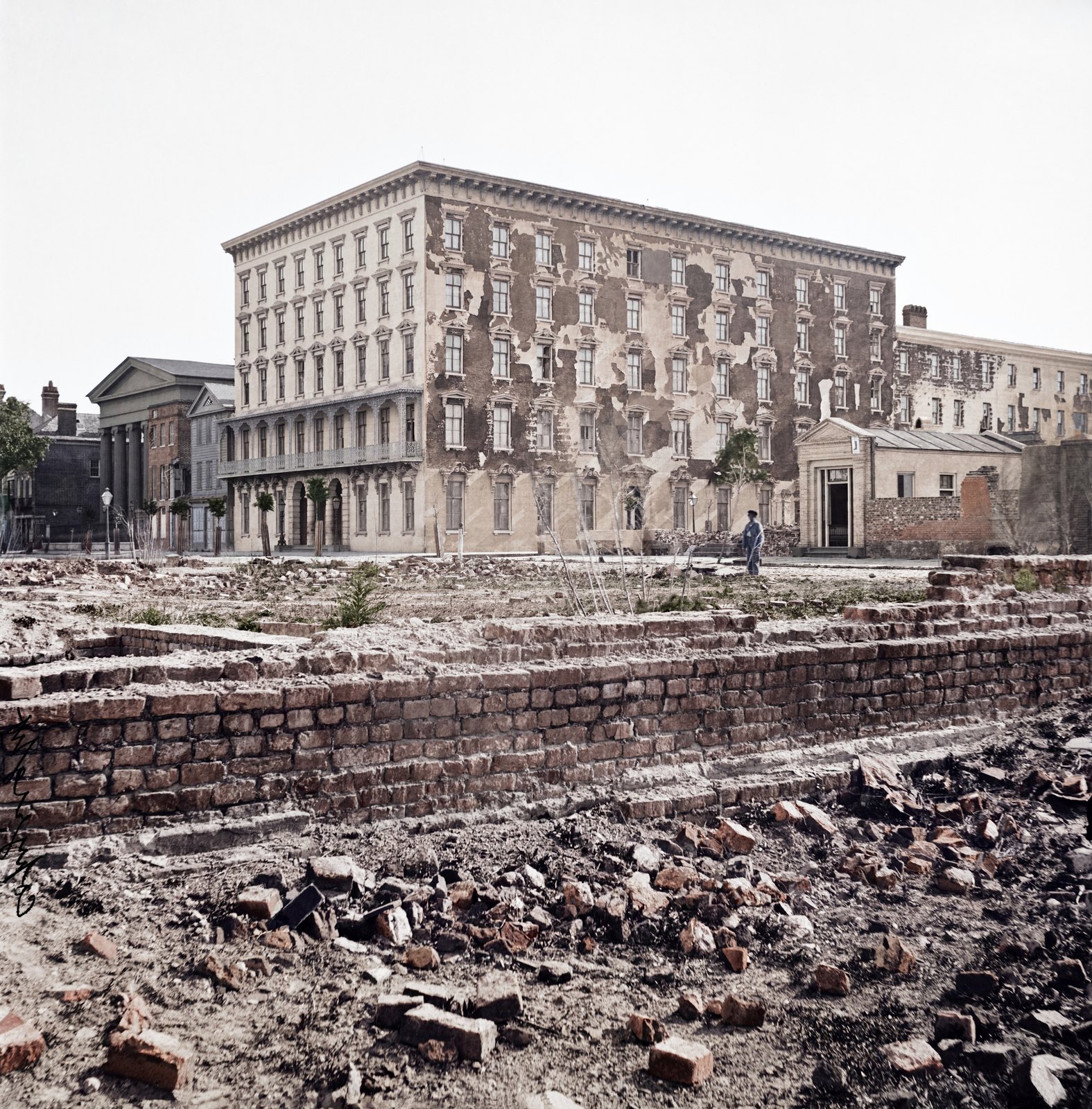
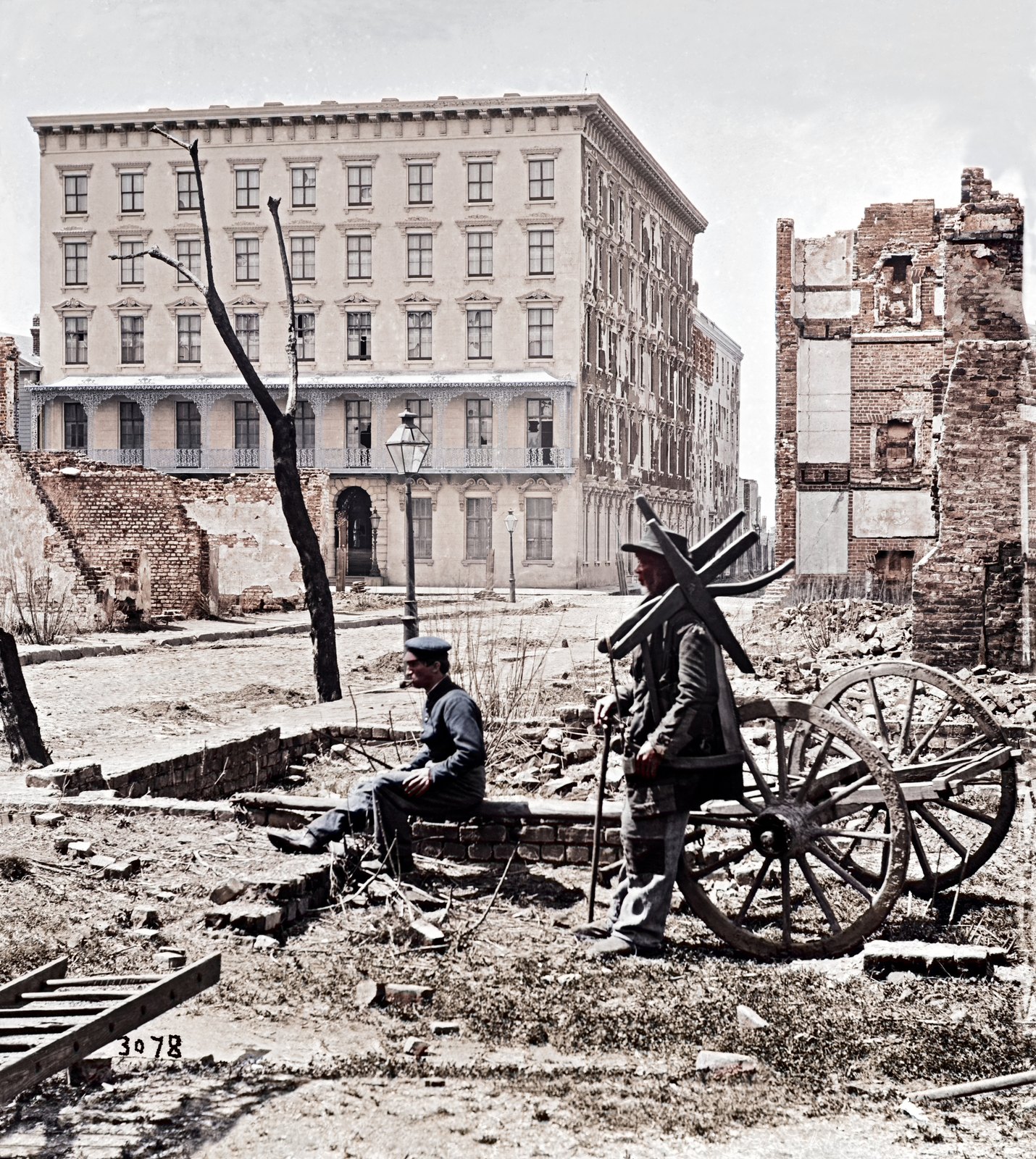
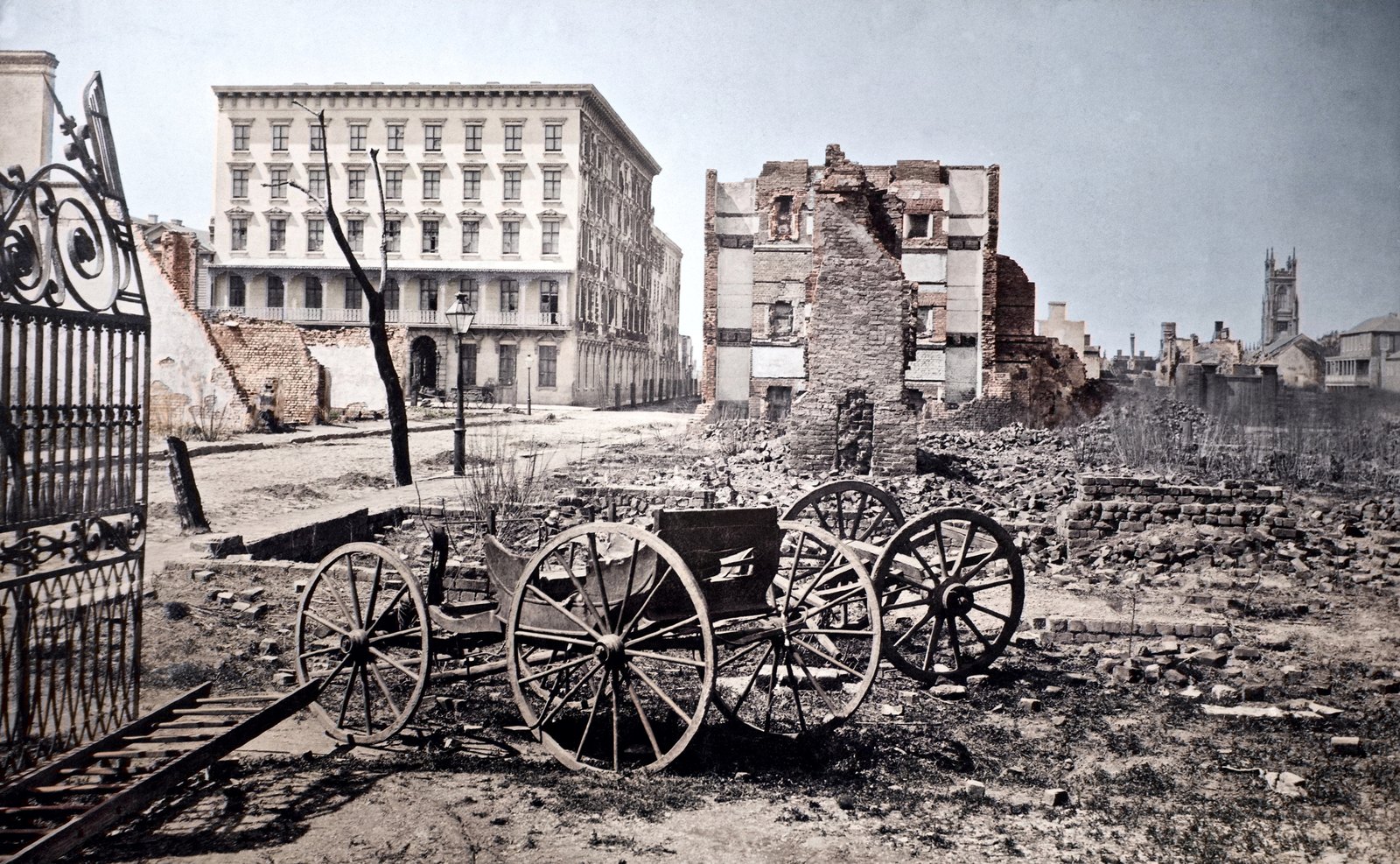
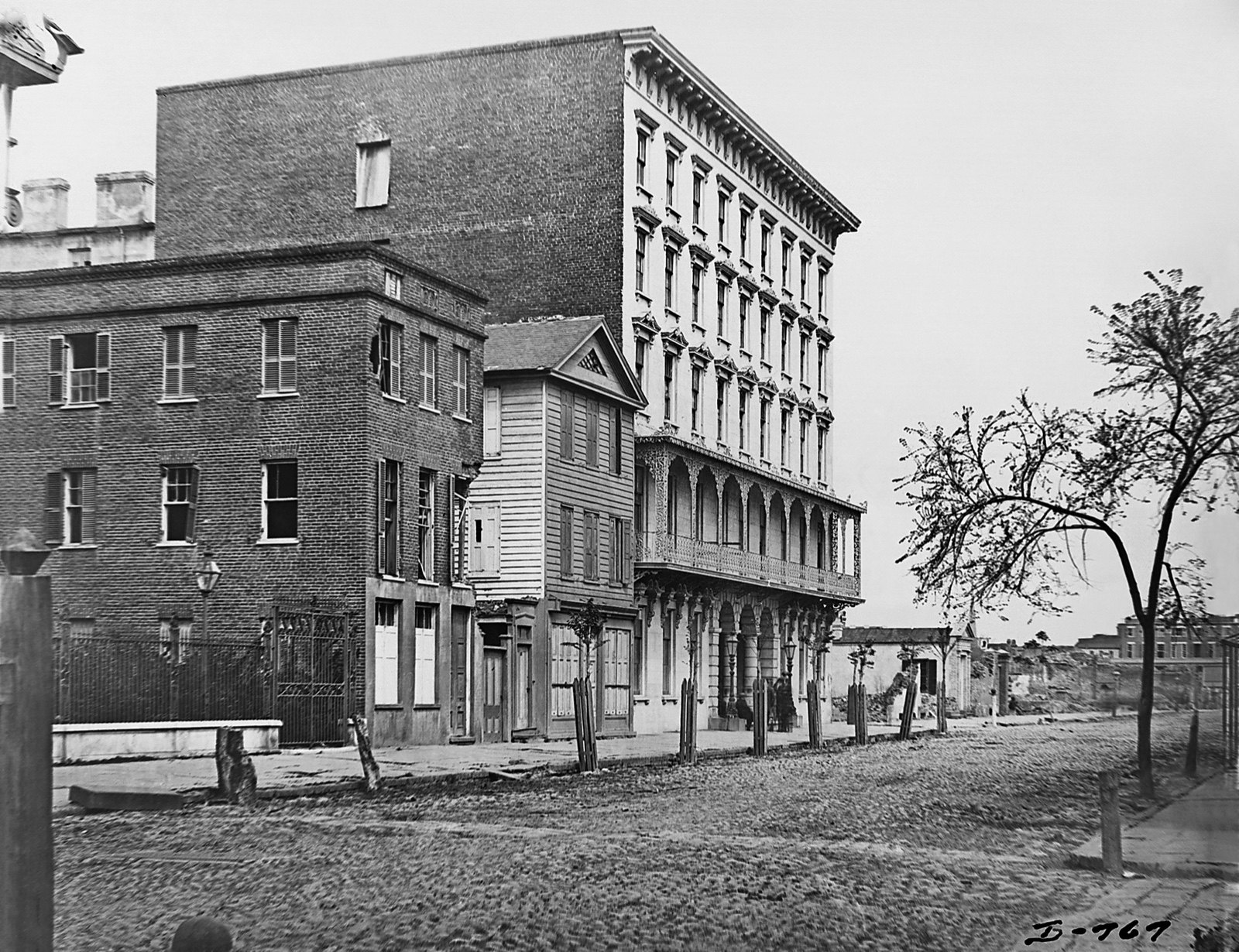
The Mills House Looking North
Charleston's most modern hotel, described by the novelist who knew the city best.
Drag to compareNational Archives
"Costly in furniture, rich in decoration" was William Gilmore Simms's verdict on the Mills House, and Simms was in a position to judge. Born in Charleston in 1806, he was the most productive Southern writer of his generation — some eighty volumes of novels, poetry, history and criticism — and the closest thing the antebellum city had to a man of letters with a national reputation.
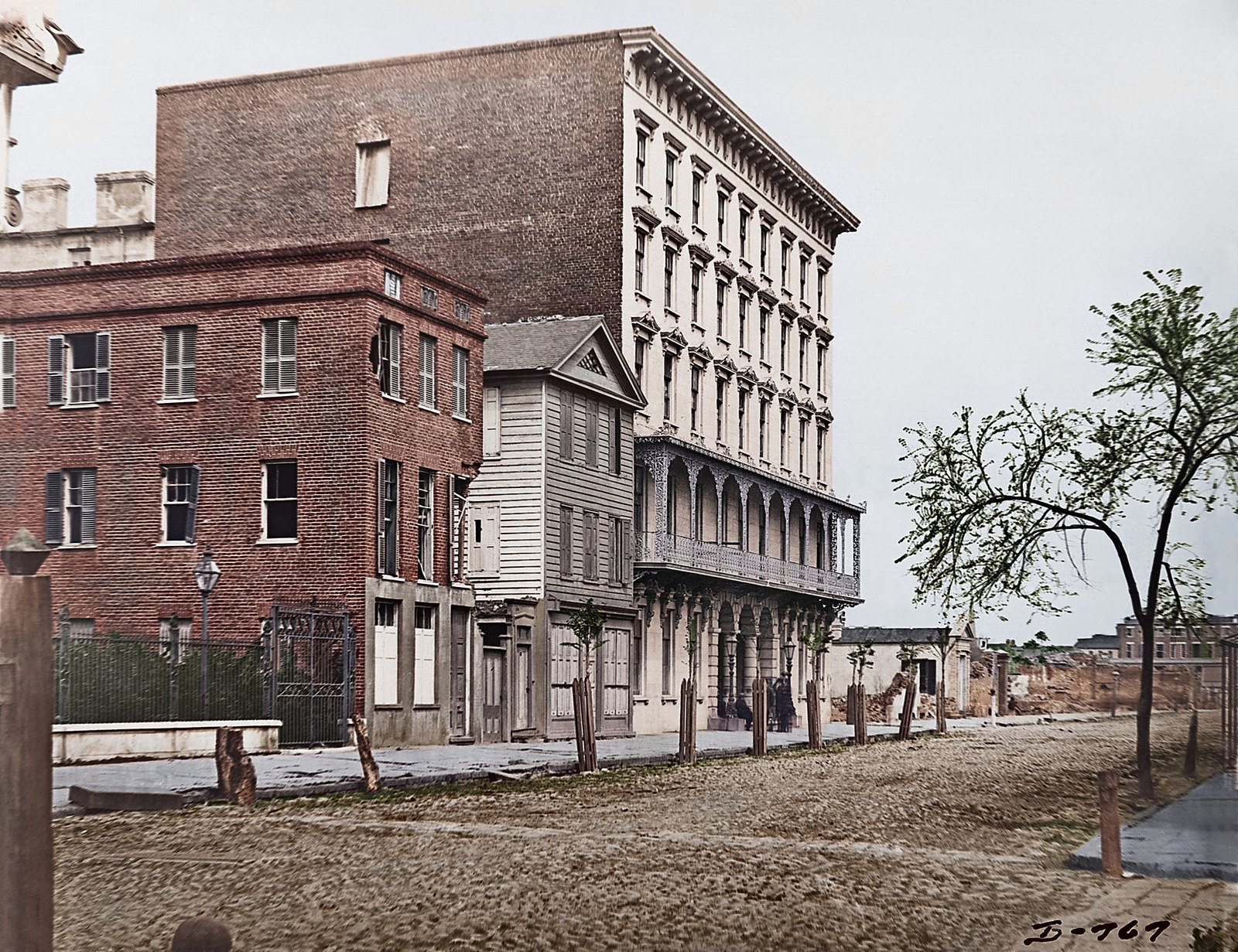
The hotel stood at the southwest corner of Meeting and Queen streets: five storeys, opened in 1853, built by the grain merchant Otis Mills to designs by John Earl. Its brick was finished in a mastic cement scored and tinted to imitate brownstone — a cheap material dressed as an expensive one, which was very much the fashion — and its cast-iron balconies were ordered from Philadelphia. It had running water and steam heat at a time when a traveller could assume neither.
This view looks north along Meeting Street. The burnt district begins immediately behind the hotel: The fire broke out on the evening of 11 December 1861 at the foot of Hasell Street near East Bay — the Mercury put it at Russell & Co.'s sash and blind factory, though others thought it was already burning in Cameron & Co.'s machine shops across the street. Driven by a hard northeast wind, it cut a diagonal swath southwest across the whole peninsula and did not stop until it reached the Ashley River below Tradd Street. It burned some 540 acres and more than a thousand buildings in a single night.
Simms lost more to the war than a hotel he admired. His plantation, Woodlands, burned in 1865 as Sherman's columns came through the interior, and with it his library. He died in Charleston in 1870, largely forgotten outside the South.
The hotel outlasted him by nearly a century and then went anyway. It was demolished in 1968; the building on the corner today opened in 1970 and copies the facade one storey taller.
The caption as printed in the book
“Costly in furniture, rich in decoration” was the way that Charlestonian William Gilmore Simms described the Mills House, the five-storied hotel at the southwest corner of Meeting and Queen Streets. Simms (1806–1870) was Charleston’s most famous antebellum literary figure. His novel The Yemassee (1835) portrayed Indian warfare in Carolina of 1715. The Partisan, dealing with the Revolutionary War, was published the same year. The hotel was owned by Charleston grain merchant Otis Mills. Designed by architect John Earle, the Mills House opened its 180 rooms in 1853. Mary Boykin Chesnut and her husband lived in Camden, S.C., but in April 1861 they were in Charleston, where James served as an aide to General Beauregard. Mary was staying at the Mills House during the night of April 11-12. Mary wrote: I do not pretend to go to sleep. How can I? If Anderson does not accept terms—at four—the orders are—he shall be fired upon. I count four—St. Michael chimes. I begin to hope. At half-past four, the heavy booming of cannon. I sprang out of bed. And on my knees—prostrate—I prayed as I never prayed before. There was a sound of stir all over the house—pattering of feet in the corridor—all seemed hurrying one way. I put on my double gown and a shawl and went, too. It was to the housetop. The shells were bursting. In the dark I heard a man say “waste of ammunition.”
Also at Mills House