The Burnt District · Book p. 118
A Lot of Shot
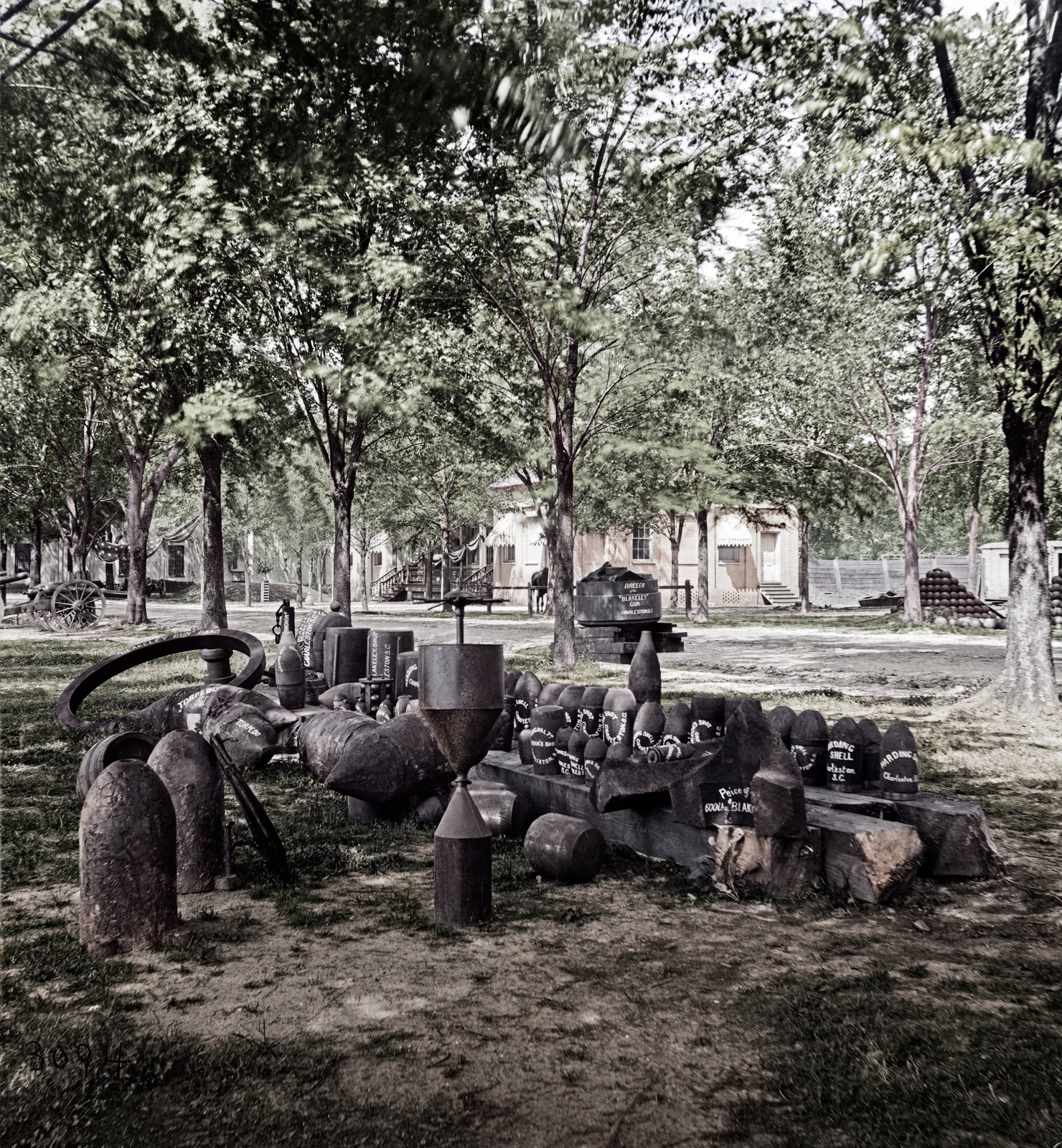
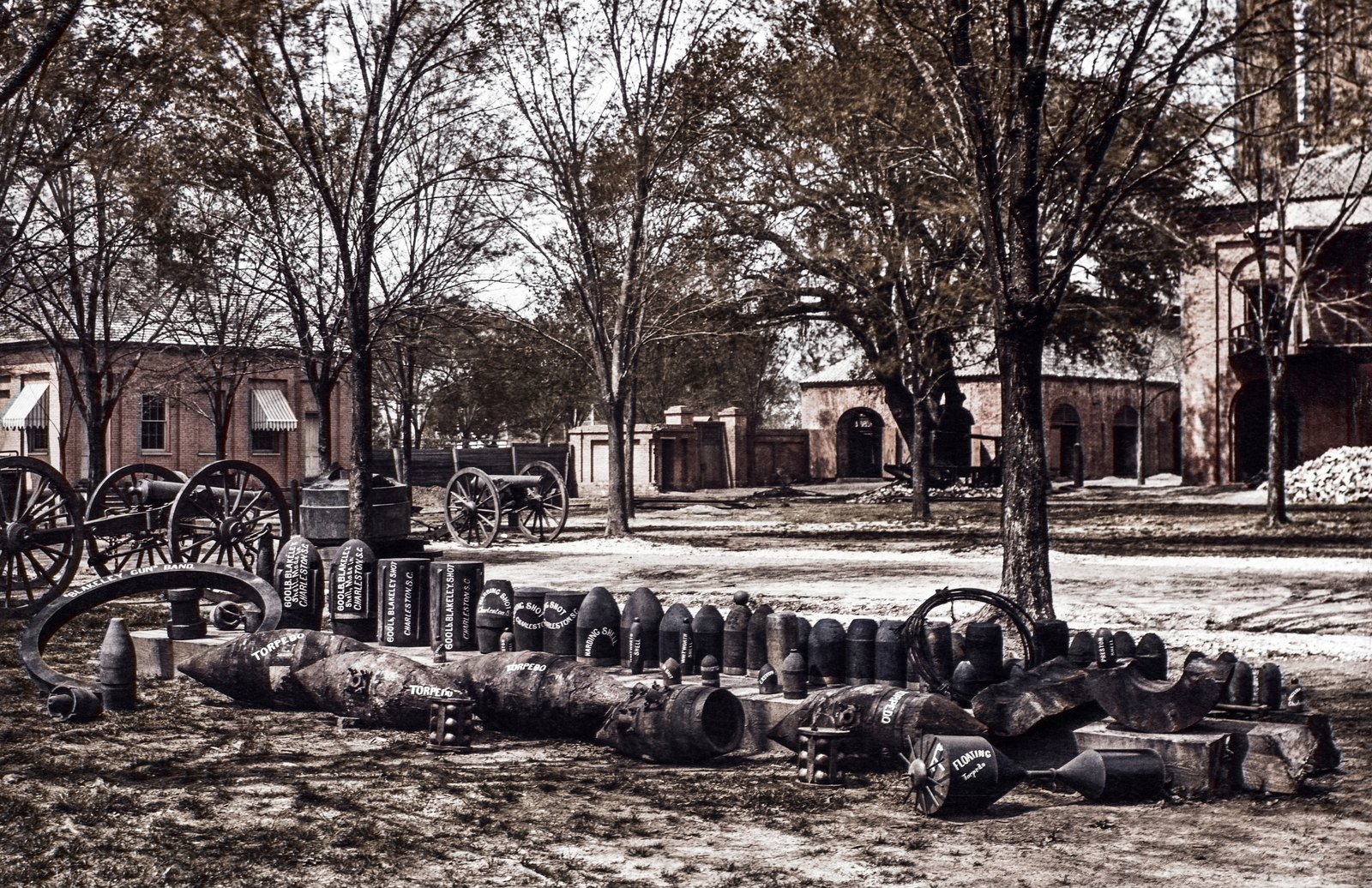
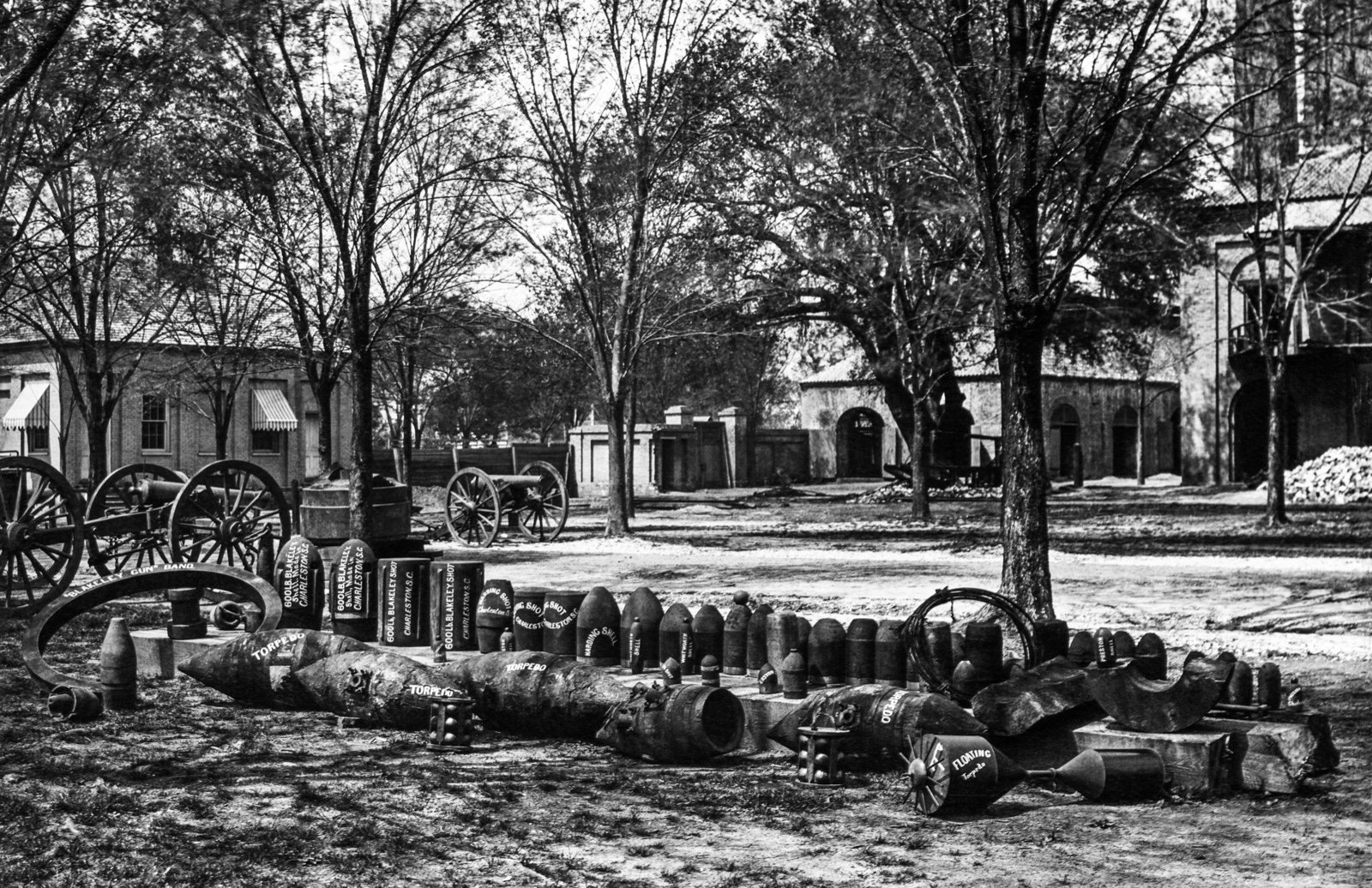
Captured heavy ordnance at the arsenal — including the band off the Blakely that burst at Battery Ramsay.
Drag to compareLibrary of Congress
This is what the Federal army found when it inventoried Charleston's ordnance after the evacuation, and for anyone who collects or studies Civil War projectiles it is one of the densest single frames in the record.
On the left is the wrought-iron band from the Blakely gun that burst at Battery Ramsay. Blakely guns were English rifles, built to the patent of Captain Alexander Theophilus Blakely, and the great ones at Charleston were among the largest pieces in the Confederacy. The band is the reinforcing hoop shrunk on over the breech to contain the pressure of firing. When one of these guns let go, the band is frequently the largest identifiable piece left.
The rest of the group is a catalog of what a besieged Confederate port was shooting and being shot with. Two 600-pounder Blakely shells and two 600-pounder solid shot. An English Lynall Thomas projectile — a patent rifle round with an expanding base. A Britten, another English pattern, with a lead-sheathed body that gripped the rifling. A pair of shells for the 12-pounder Whitworth, the hexagonal-bore British rifle whose bolts are unmistakable because the projectile itself is twisted to match the bore.
Other pieces here carry the names Harding, Eason and Preston. Eason is the local one: James M. Eason's foundry on Charleston's East Bay was among the Confederacy's few sources of heavy projectiles, and rounds bearing his name were made within a mile or two of where they are lying in this photograph.
What the group really documents is dependence. A Confederate port at the end of 1864 was firing English patents bought through the blockade alongside whatever a local iron founder could turn out, and cataloging the difference is how a collector still tells one fragment from another.
The caption as printed in the book
“Heavy metal” gets meaning from some of the ordnance seen here. To the left is the band of the Blakely gun demolished at Battery Ramsay. Also, two 600-pounder Blakely shells, two 600-pounder shot, an English Lynall Thomas projectile, Britten, and a couple shells for the 12-pounder Whitworth rifle. Other projectiles bear the names of Harding, Easton [Eason] and Preston.
Also at Charleston Arsenal