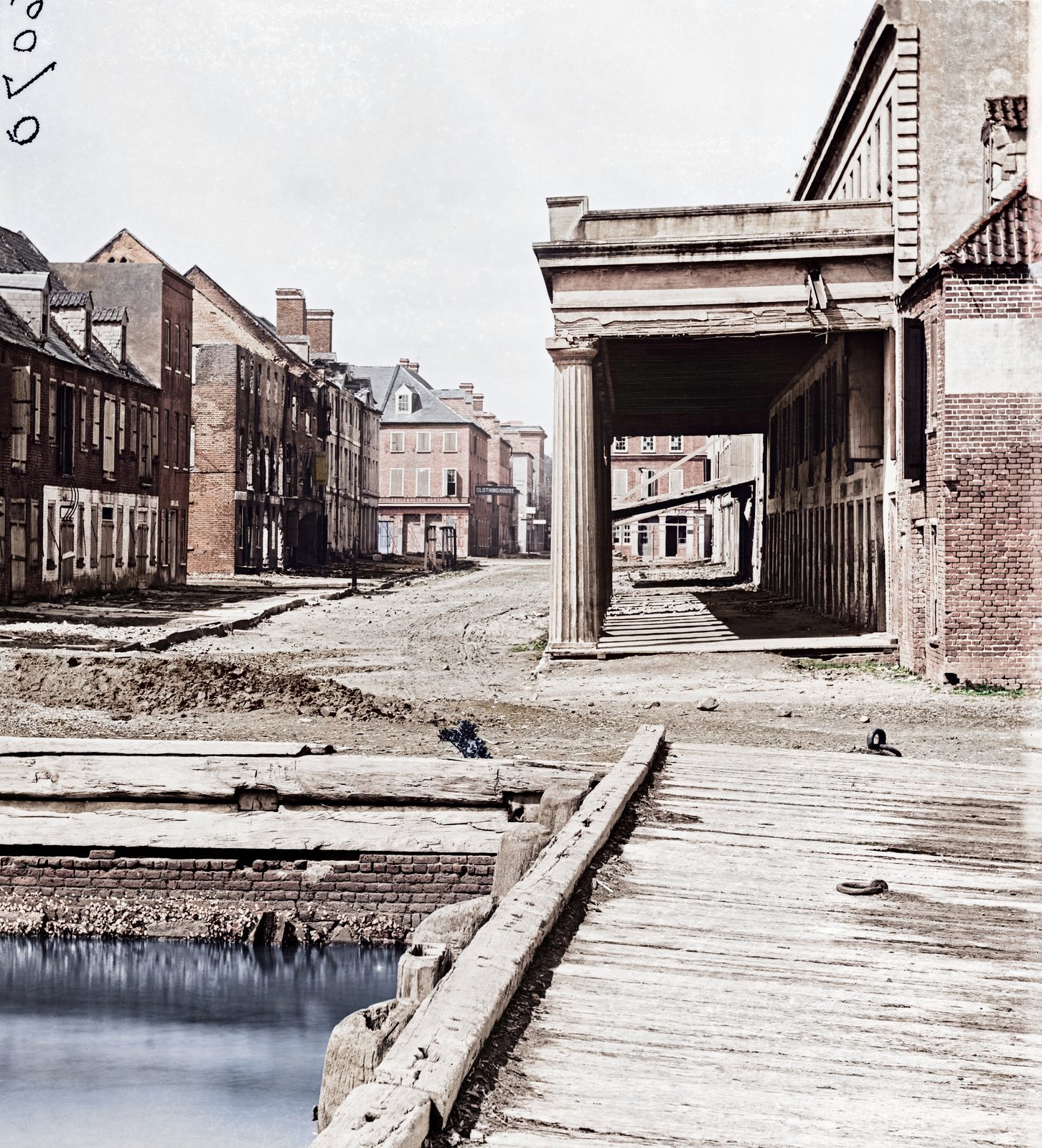
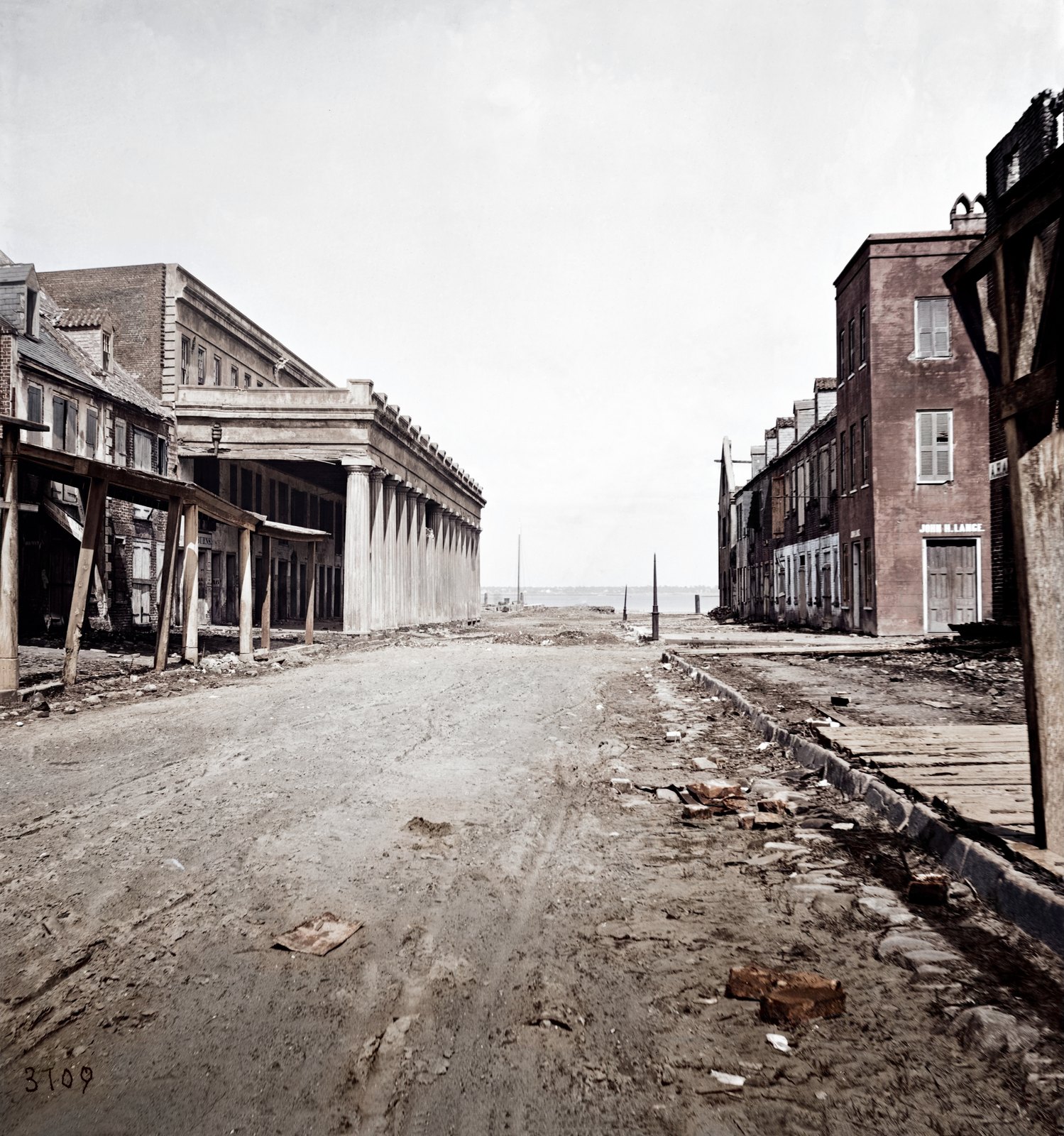
Charleston Scenes · Book p. 59
Shell Damage at Vendue Range
The auction houses on the Cooper River waterfront, with the marks of the longest bombardment of the war.
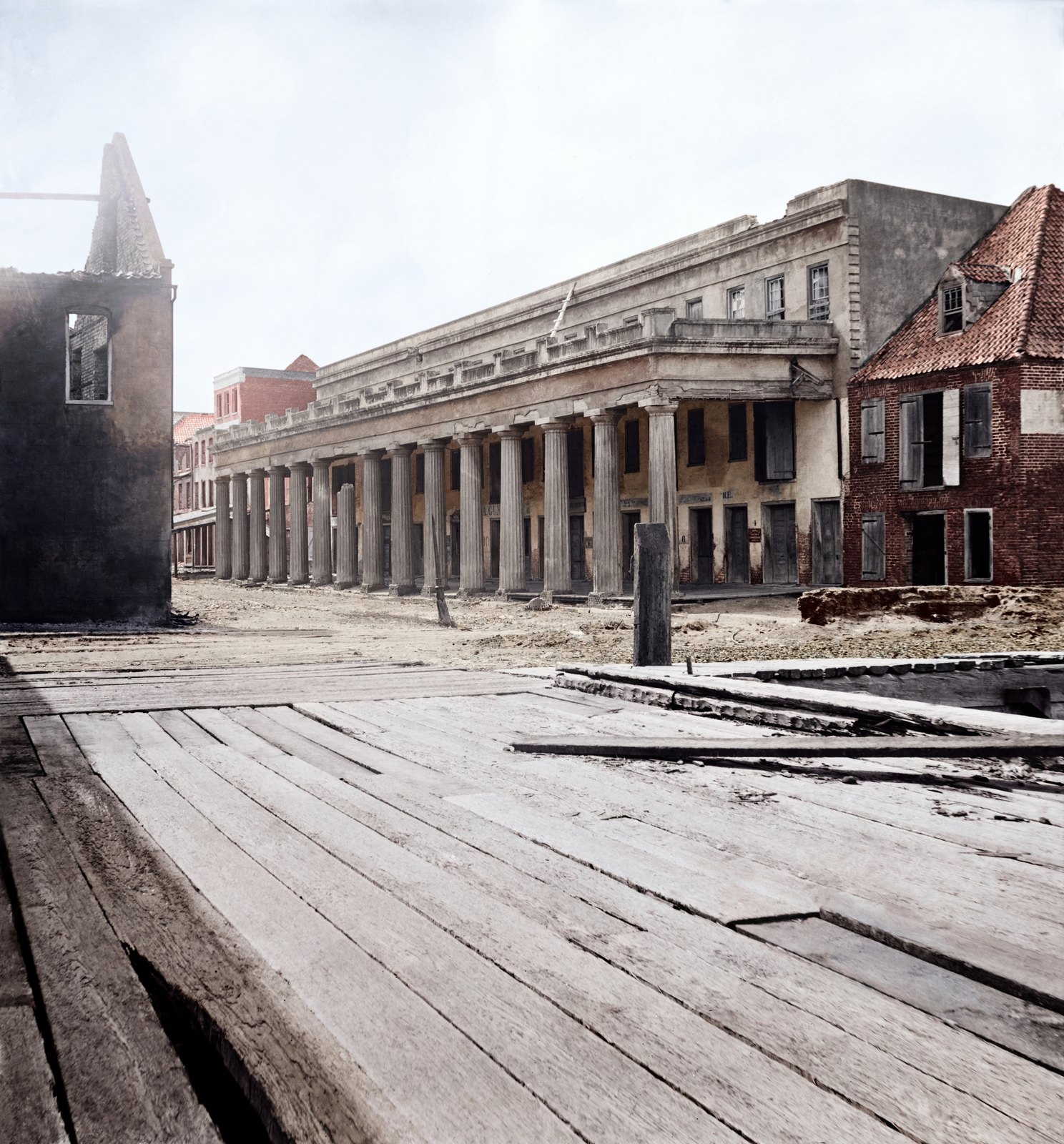
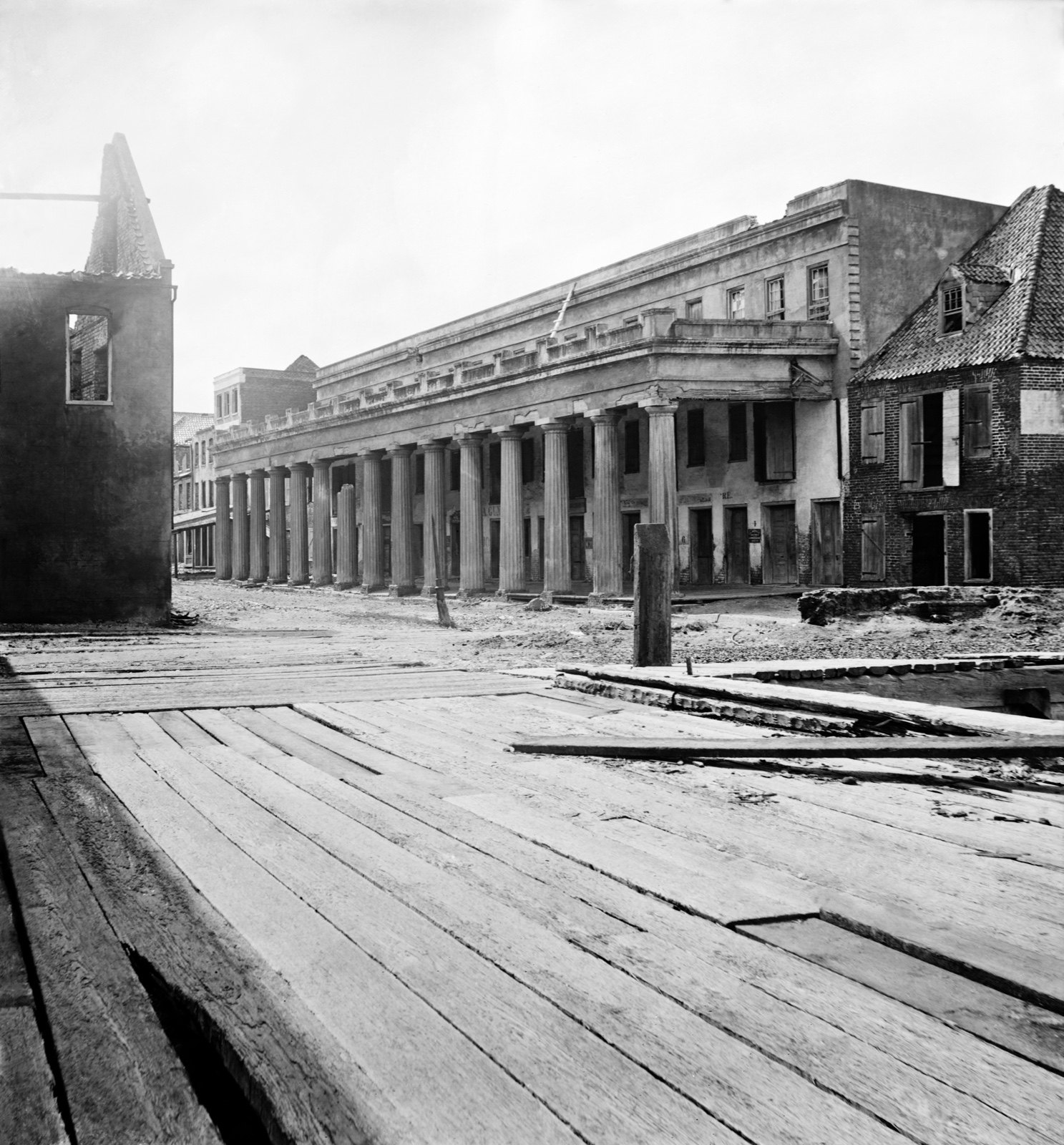
Drag to compareLibrary of Congress
Vendue is an old French word for a sale by auction, and Vendue Range was exactly what the name says: a short commercial street running east from East Bay to the Cooper River waterfront, laid out by the city after the Revolution as space for the auction trade. Cargo came off the ships, went under the colonnade, and was sold.
By 1861 the range had settled into a line of auction houses and commission merchants. This view looks west from a ferry slip, back up the range toward East Bay, and the damage is not subtle once you know to look for it: Peter Brown's tavern stands burnt out at the left, and about two-thirds of the way down the colonnade a pillar has been smashed clean through.
That damage arrived from Morris Island, four to five miles away. The Federal bombardment of Charleston opened at 1:30 a.m. on August 22, 1863, when Quincy Gillmore's 8-inch Parrott rifle — the “Swamp Angel,” mounted on a piled platform in the marsh — put its first 150-pound shell into the city. That gun burst on its thirty-sixth round, but the batteries that replaced it kept at it, on and off, into February 1865. Richard W. Hatcher III, longtime historian at Fort Sumter, estimates that more than 12,500 Parrott projectiles — 30-, 100-, and 200-pounders — were fired into Charleston across the siege. No American city has ever been shelled longer.
What that meant to the people living under it comes through best in the letters of Sgt. Augustine Smythe, who wrote to his mother on December 11, 1863:
The Yankees shelled again last night at three intervals 8 P.M. 2 A.M. & 4:30 A.M. Again this morning & they even threw one just now. I have heard only where a few went. One corner Pitt & Beaufain, one corner Rutledge & Beaufain, one in Elliott St. near Church & one on Vendue Range. They all pass above me here & I now hardly stop writing when they pass over. It is a horrible thing this shelling the city at night, & with pauses between as if to catch unawares, when they know that there are women & children in the city.
Smythe names Vendue Range in that list. The pillar in this photograph is the kind of thing he was writing about.
The caption as printed in the book
Vendue is an old French word referring to public sale by auctioning. After the American Revolution, Charleston’s officials began creating commercial space for vending along a short street north of Queen, running from East Bay to the Cooper River waterfront. By the time of the Civil War, the line of auction houses looked like this. The view is to the west from a ferry slip. Shell damage is evident, both in Peter Brown’s burnt-out tavern to the left and the smashed pillar two-thirds down the length of the range. On Dec. 11, 1863, Augustine Smythe wrote his mother about the Federals’ bombardment. The Yankees shelled again last night at three intervals 8 P.M. 2 A.M. & 4:30 A.M. Again this morning & they even threw one just now. I have heard only where a few went. One corner Pitt & Beaufain, one corner Rutledge & Beaufain, one in Elliott St. near Church & one on Vendue Range. They all pass above me here & I now hardly stop writing when they pass over. It is a horrible thing this shelling the city at night, & with pauses between as if to catch unawares, when they know that there are women & children in the city.
Also at Vendue Range