The Holy City · Book p. 124
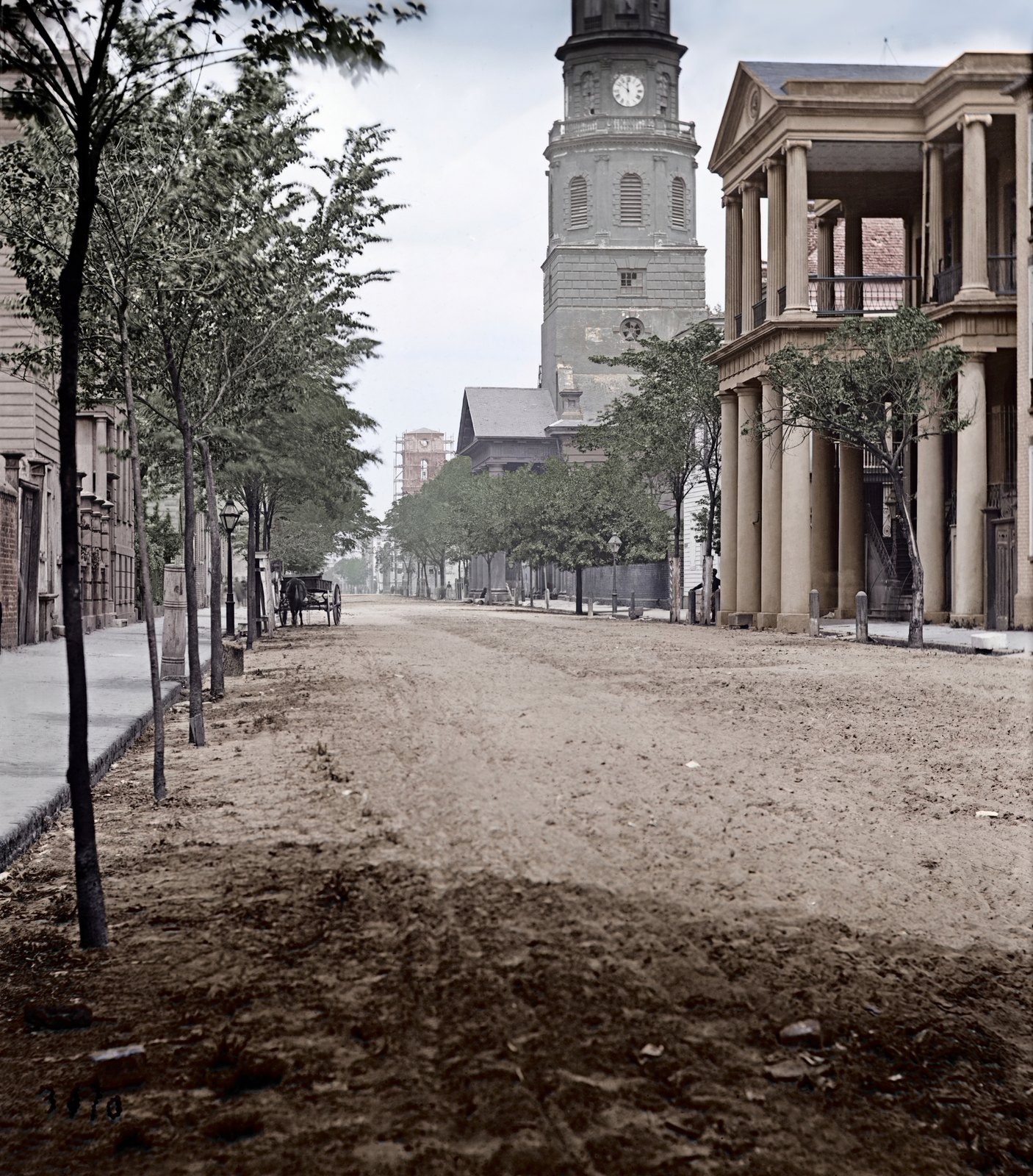
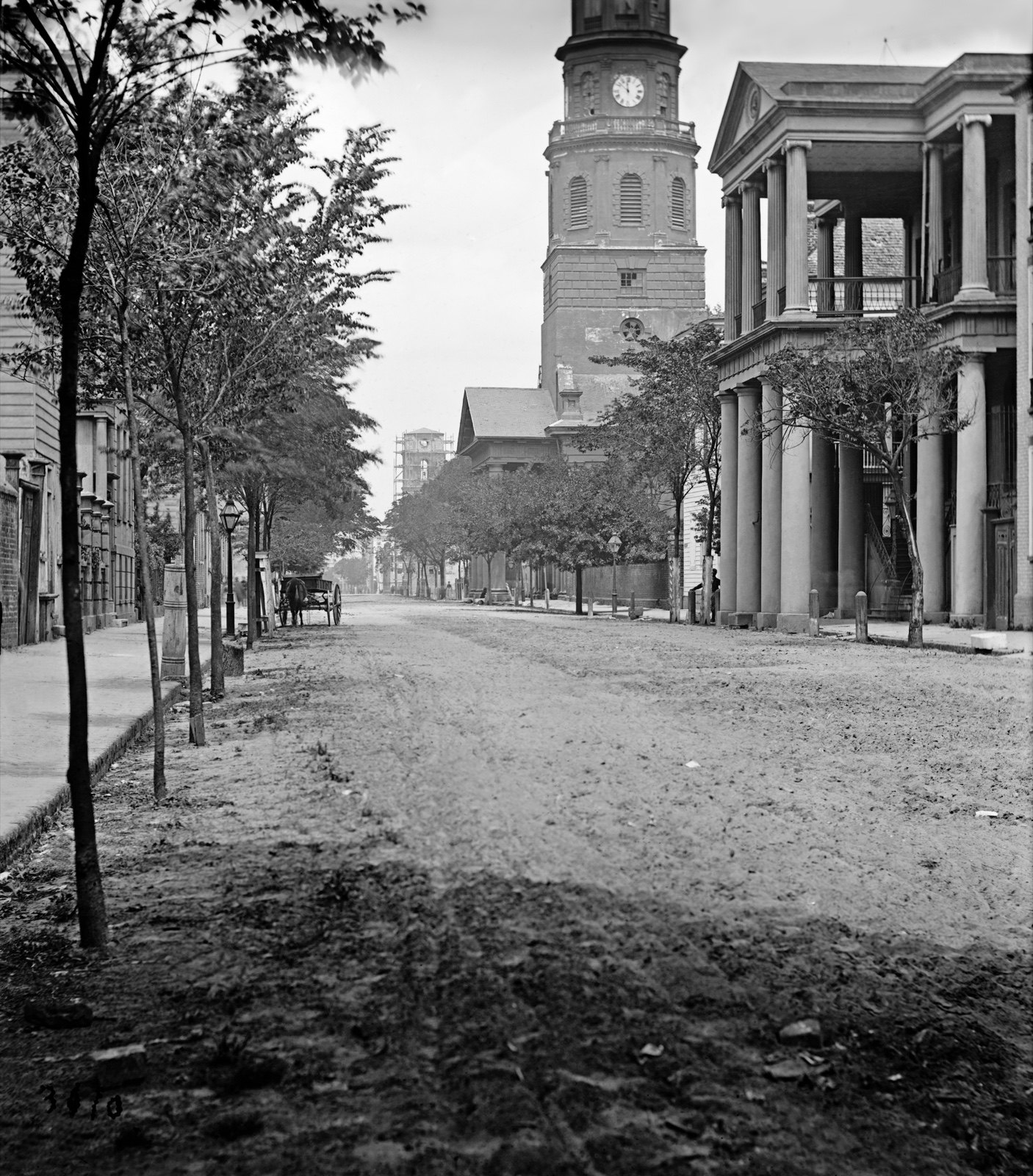
Meeting Street, Looking Up to St. Michael's
The oldest church building in Charleston, photographed from an unpaved street in the spring of 1865.
Drag to compareLibrary of Congress
Before they were Americans, Charlestonians were Anglicans. Charles Town's first church was St. Philip's, put up on Meeting Street near Broad in the 1680s — black cypress on a brick foundation. Its first clergyman, Atkin Williamson, left behind a reputation that has outlasted his ministry: the story, repeated in Charleston for three centuries, is that he was once so far gone in drink that he baptized a bear.
St. Philip's moved. As the colony's newcomers arrived by sea rather than overland, the congregation relocated toward the Cooper River docks, holding its first services at the Church Street site on Easter Sunday 1723. The old Meeting Street lot did not stay empty long. The city was growing fast enough by mid-century to need a second Anglican parish church, and the cornerstone of St. Michael's was laid in February 1752. The sanctuary opened for services in 1761.
That is the steeple in this photograph — 186 feet of it, the tallest thing in Charleston for most of the city's history and the first landmark a ship's master picked up coming in over the bar. It has been a navigation mark, a fire lookout, and an artillery aiming point, which is the reason for the most striking thing about it during two wars: the spire was painted black. It was done first during the British siege of 1780 and again during the Civil War, on the theory that a black steeple would be harder for enemy gunners to lay on at night. Whether it ever worked is doubtful. The church took a shell in the chancel during the Federal bombardment, but the steeple came through.
Because fire destroyed St. Philip's in February 1835, St. Michael's is the oldest church edifice standing in Charleston — the building in this photograph, not a replacement of it.
The view looks south down Meeting Street. The street itself is worth as much attention as the church: unpaved, deeply rutted, drifted with the pale sand that lies under the whole peninsula, with a single cart standing at the left curb and almost no one about. This is a city that has just come through a five-hundred-day bombardment and a change of government, photographed in the quiet immediately afterward.
Gen. Robert E. Lee worshiped at St. Michael's during the war. So, in their turn, had George Washington and Robert Barnwell Rhett.
The caption as printed in the book
Before they were Americans, Charlestonians were Anglicans. Charles Town’s first church was St. Philip’s, on Meeting street near Broad. Members of the Church of England could be bibulous, including their priests. St. Philip’s first clergyman, Atkin Williamson, was said to have once been so drunk that he baptized a bear. St. Philip’s moved to a new location, closer to the Cooper River docks, when Charlestonians realized that most newcomers were arriving by sea. First services at its second (and current) site on Church Street were held on Easter Sunday 1723. Replacing the original wooden St. Philip’s—black cypress on a brick foundation—was Charleston’s second Anglican church, St. Michael’s. The city was growing so fast in the 1700s that parishioners needed a second worship-place. Its cornerstone was laid in February 1752. The sanctuary opened for services nine years later. During the American Revolution and the American Civil War (Southerners used to call it the Second American Revolution), St. Michael’s spire was painted black to make it less visible to enemy artillerymen—both redcoats and bluecoats. Because a fire in February 1835 destroyed St. Philip’s, the building you see in this photograph is the oldest church edifice in the city of Charleston. During the war, Gen. Robert E. Lee worshiped at St. Michael’s.